
Knowledge HUB
Beacuse we belive that sharing the knowledge is the best way to innovate
North Star Metric – how to align your product teams
In this article I explain what the North Star metric is and how to create one for your audio product so it can help align teams around the customer value and business growth.
Why search for the ultimate metric
As a product director, I looked for a way to make sure that product teams were fully focused on the priorities. At the same time, I strongly believe that things need to be kept simple and teams must be focused on making a real impact instead of tracking too many metrics. I also know that for some team members – especially software engineers or designers – revenue, CAGR, profitability were not metrics they could relate – they wanted to see that the product is useful to the users.
This is when I recalled the research program I took part in – a PhD researcher was evaluating product management tools used by experienced practitioners. When asked how they manage a product strategy, a lot of them claimed to use North Star.
What is the North Star metric
The North Star Metric (NSM) originated in Silicon Valley product companies as a response to teams optimising for fragmented or misleading KPIs. The concept was popularised by product leaders and growth teams at companies like Facebook, Airbnb, and Spotify, and later formalised by product organisations such as Amplitude and Reforge.
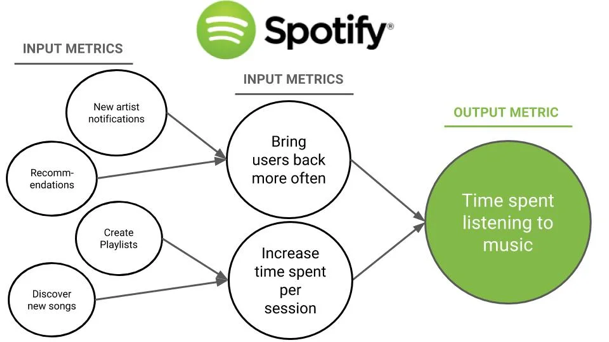
Pic 1 – Spotify’s NSM
A North Star Metric is supposed to be the most important metric that captures the core value a product delivers to its users. It is designed to align customer success with long-term business growth but speaks the language understood by the teams. It is an effective way to align discovery, delivery, and growth around one clear definition of success.
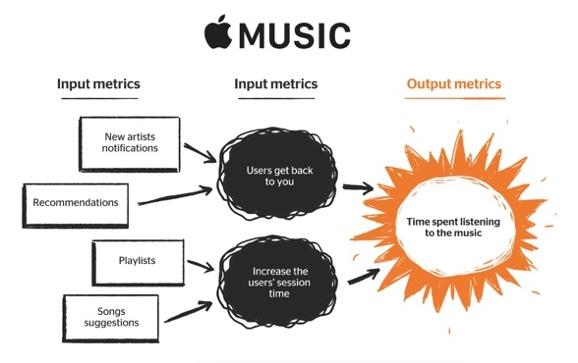
Pic 2 – Apple Music’s NSM
Today, North Star Metrics are widely used by product managers, growth teams, founders, and executive leadership in technology companies, including some music tech teams – see the above pictures from Spotify and Apple Music.
Let’s give a try
I was hesitant at first as this framework originated in Silicon Valley at the very specific types of companies (product-led growth with B2C software), where I was hoping to implement it for professional software with a very expensive licensing. But there is no harm in checking things out. I read all the articles I could find, created a Miro board with a template and organised a workshop with one of the product teams.
Here is my Miro template you can use for workshops
It is important to build NSM together with all teams – Design, Engineering, Marketing and Sales. This way the metric created will be widely accepted and each team will understand how their own KPIs contribute to the NSM and overall success of the product.
How to build a North Star metric
To build an NSM, you need to:
- Create a list of all major user tasks in your products
- Assign KPIs to those individual tasks (Input Metrics)
- Try to find a common denominator between input metrics – one dimension that can reflect the input metric – this is your NSM
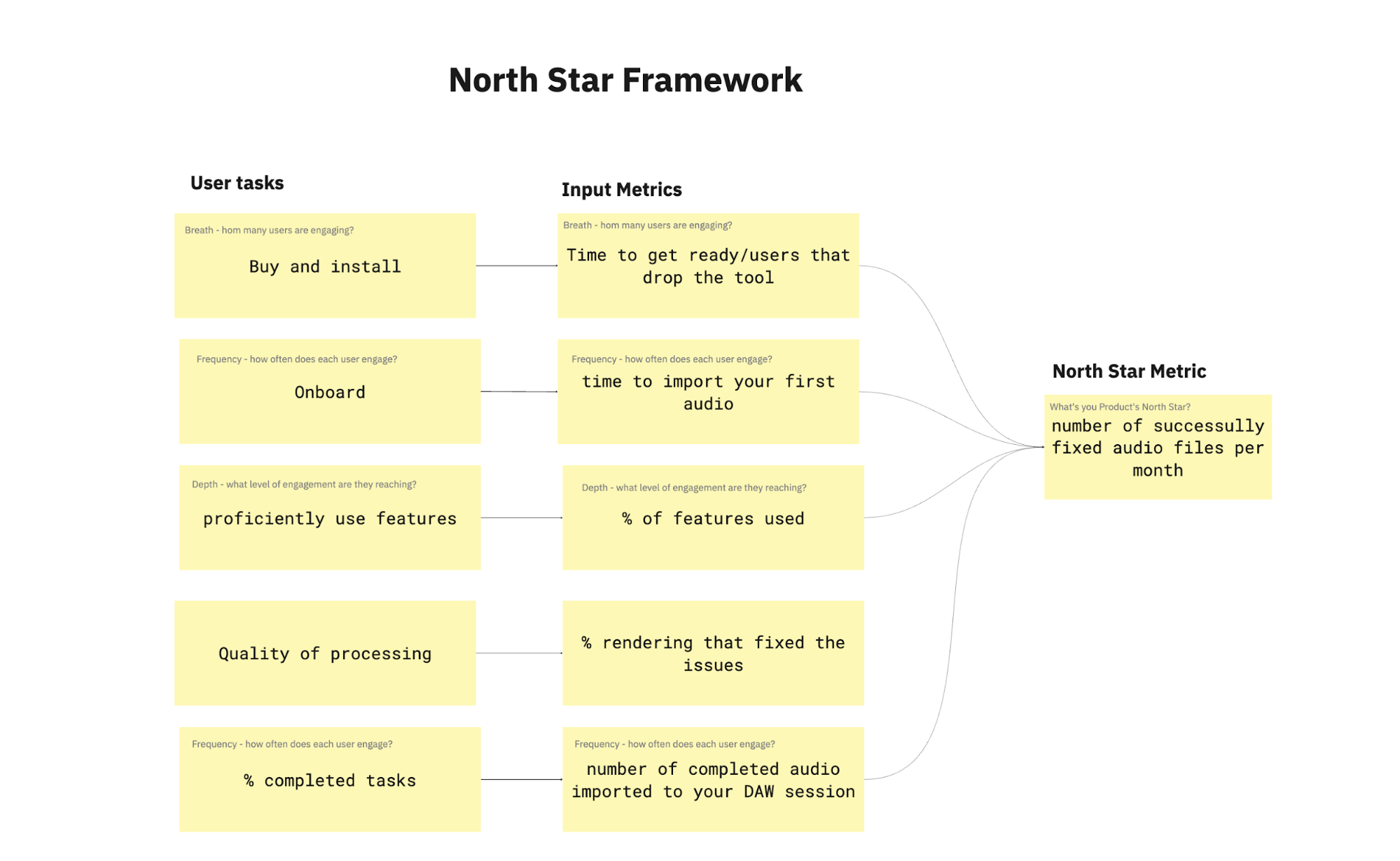
Pic 3 – NSM Framework (own work)
I cannot share the NSMs I built for my teams. So in order to give you a practical example, let’s use an audio product known to everyone – iZotope RX.
How to build a North Star metric
Understanding RX’s Core Value
iZotope RX is a restoration tool designed to rescue audio that would otherwise be unusable: noisy dialogue, clipped recordings, damaged archival material, or problematic field recordings.
The true value of RX is not how often it is opened, but how much broken audio it successfully saves.
Analysing the input metric
In the below diagram, I decomposed the user workflow – from buying the product on the website or some plugin marketplace, activating it, through onboarding the user when he/she tests different restoration tools, to finally importing their fixed files into a Digital Audio Workstation (DAW).
Pic 4 – NSM for iZotope RX (own example)
From the above analysis, I think the North Star for RX could be:
Number of audio projects restored to professional quality per active user per month
or
Number of hours of usable audio restored to professional quality per active user per month
Why This Metric
This metric captures the outcome RX is built for: turning unusable audio into production-ready material. It avoids proxy metrics like feature usage and focuses directly on successful restoration. The more audio a user successfully restores,
- The more RX becomes embedded in their workflow
- The higher the likelihood of retention and upgrades
- The stronger the long-term revenue relationship
Value creation and revenue growth are tightly linked. While you use the language understood by the audio teams, the outcome should result in improved financial results for the product.
How NSM can be cascaded onto different teams
Every team can directly influence this metric:
- Product teams prioritise the highest-impact restoration use cases
- DSP teams improve algorithm effectiveness and reduce artefacts. It also creates new algorithms that are required to provide high-quality audio files (as requested by the product team)
- UX teams improve the interface to shorten the onboarding time and increase adoption (people understand how to use features)
- Engineering teams ensure compatibility and bug-free experience with the most important DAWs and Operating Systems so the tool can be widely adopted by all professional users (Mac and Win alike with Pro Tools, Cubase, Logic Pro and any other DAW).
- Marketing and Sales teams create materials that are to increase conversion and provide frictionless onboarding and installation
- Support teams reduce time-to-success for new users and remove friction to ensure existing users can complete their projects on time
Supporting Metrics (Not the North Star)
To make the North Star Metric actionable, RX teams can track supporting input metrics such as:
- Percentage of restored audio accepted without rework
- Average time to reach acceptable quality
- Artefact or quality complaint rate
- Feature-level success rates (Dialogue Isolate, De-reverb, Spectral Repair)
An Enterprise-oriented NSM
For broadcast or enterprise environments (e.g. major media outlets, movie production, etc), a more delivery-focused alternative could be:
Percentage of audio projects delivered on time thanks to RX
This could help organisations that measure success primarily through deadlines and service-level commitments.
Conclussion
As we can see in the RX example, the North Star can be a simple but powerful framework to align teams on user value and business growth. I was initially sceptical as it originated in Silicon Valley, but later I learned that it could work in any industry, both for products and services, B2B, and B2C alike.
I believe that frameworks like NSM gain a new meaning as many companies embrace remote work and AI tools, so it is harder to keep everyone on the same page when you have less interaction.
Thank you for reading!
Bonus: our AI prompt you can use to generate NSM.
We also invite you to the AI-Augmented Product Manager workshops!
Related articles
Audio Pricing Models Pt. 2
Knowledge HUBBeacuse we belive that sharing the knowledge is the best way to innovateIf revenue, sales, and other quantitative indicators were the only things justifiable when constructing pricing, income wouldn’t be an issue. Specifically, considerations regarding...
Digital Audio: Digitization
Knowledge HUBBeacuse we belive that sharing the knowledge is the best way to innovateAfter reviewing the audio history and how sound is created, let’s start diving into digital system processing by first of all understanding how analog audio becomes digital from an...

Introduction to product roadmaps
Knowledge HUBBeacuse we belive that sharing the knowledge is the best way to innovateIn this article, I would like to give you a short introduction to the roadmaps – one of the basic product management tools. How to build and use them? Let’s reviewWhat is RoadmapIt is...

Audio Pricing Models – Part 1
Knowledge HUBBeacuse we belive that sharing the knowledge is the best way to innovateRegardless of the product and its features being offered, product teams have a lot to consider when choosing a pricing model. I believe the primary consideration that any product...

Sound from the beginning
Knowledge HUBBeacuse we belive that sharing the knowledge is the best way to innovateIf you new to physics of sound, it will help you to understand the basic concepts.Physics of SoundLet’s start from the beginning. What is the sound? What do you remember from the...
Would like to receive our product newsletter?
